

Where Jev goes, and where n8n goes
n8n runs the workflow; Jev classifies the payload. A practical division of labor and the official metering of each.
Product claims checked against the official documentation linked below. Vendor benchmarks are attributed to the vendor.
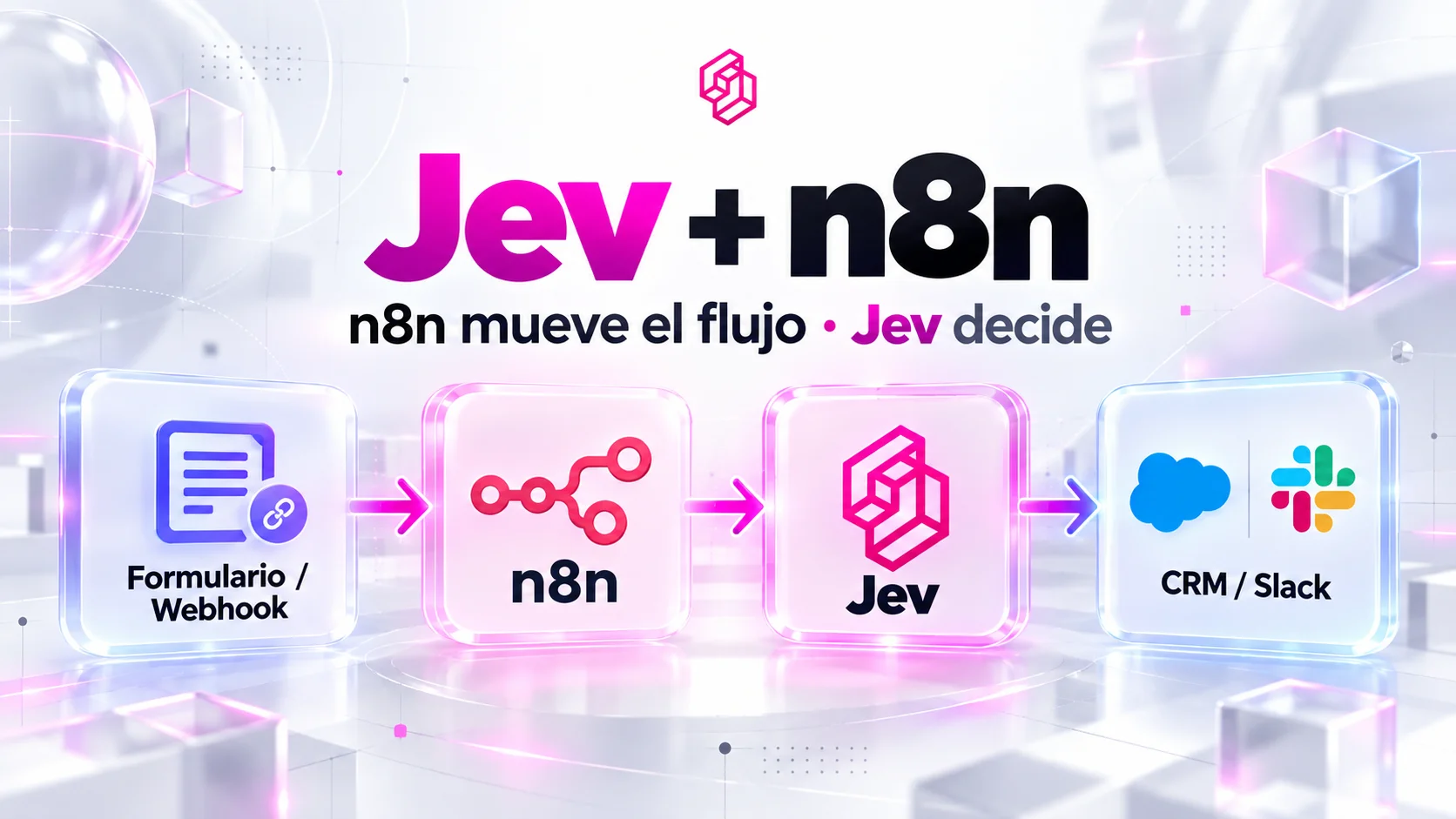
They showed up in the same feeds in September and people started pairing them as if one might replace the other. They do not. n8n moves a record from one system to the next. Jev answers a closed question about that record. One is the pipe. The other is a function you call in the middle of the pipe.
If the job is “when a form is submitted, write a contact and ping Slack”, you do not need Jev. If the job is “which of these four queues, and should a human see it before the CRM write”, a chat completion is the expensive way to ask.
What each one meters
n8n is a workflow tool. A workflow is a graph: trigger, then nodes. An execution is one run of that graph, from the trigger to the end. On the pricing page the meter is executions, not steps and not seats. A 12-node run and a 3-node run count as one execution each, which is the point they advertise against tools that bill per action. Paid plans count production executions — the ones a trigger, a schedule or a poll actually starts. Manual test runs do not eat the quota. Self-host exists; the cloud plan is not the only way to run it.
Jev is a model. One HTTP call, POST /v1/systemone on api.typesafe.ai. You send state and typed questions. You get a choice, a score or a yes/no, each with a probability. Official card on 2 October 2026: $0.042 per million input tokens, output not charged. It does not send the Slack message, and it does not hold your CRM credentials. The piece on what it is, and the wrappers that charge more, is Qué es Jev.
| n8n | Jev | |
|---|---|---|
| Unit of work | one workflow run | one decision call |
| Holds secrets | yes, for the apps it talks to | no |
| Writes to the CRM | yes, via a node | no |
| Classifies a payload | only if you put a model node in | yes, that is the product |
| Bill shape | executions / month, or a server if you self-host | input tokens |
| Fails as | a stopped run you can replay | a wrong-but-valid label |
The shape that actually fits
Form → webhook → clean the fields → ask Jev → branch → CRM and Slack.
The webhook is n8n. Trimming the name, lowercasing the email, normalising the phone: n8n, in a Set node or a few lines of code. The questions are Jev’s:
queue: billing, technical, sales. A Choice, with a criterion on each label.wants_human: a Noul. “This message asks for a person, or is too angry to auto-answer.”fit: a Score, if you insist on ranking leads. Optional. Most desks do not need it on day one.
Then a branch you wrote. High probability and a safe queue: create the contact, post to Slack, stop. Low probability, or wants_human: create the contact anyway, but assign a person and do not send the automatic reply. The reply, if you send one, comes from a template or from a chat model. Not from Jev.
That last sentence is the cut people skip. Jev will not draft the email. Asking it to is how you end up with a blog post that says the model “writes and routes”. It routes. Something else writes.
What you should not put on the Jev call
The state should be the message, plus the three fields you already trust (plan, country, source). Not the whole HTML of the landing page. Not the last 40 emails. Input is the only thing Jev bills, and the context cap on the model card is 64k, with 32k for the state plus the longest question. A fat state is a slow, pricey, worse decision.
Do not ask an open question. “What should we do with this lead?” is not a Choice. If you cannot list the labels before the call, you are not ready for this node.
Do not hide the threshold in the model. Pick it on a few dozen labelled messages from your own inbox. 0.8 from a launch thread is not your number.
When the chat node is still the right node
n8n has AI nodes, and they earn their place when the output is text or a tool call you could not enumerate:
- a first-draft reply a human will edit,
- a summary of a long thread for the person who owns the account,
- a tool choice over an open catalog (search the CRM, draft, do nothing) where the catalog does not fit in a Choice of 255.
They are the wrong node for a closed enum you already know. A $2-per-million model, prompted to “reply with only the word billing”, still sometimes replies with a sentence, and you pay output tokens for the privilege. Jev’s failure mode is a wrong label. The chat’s failure mode is a label you have to parse. For a queue, take the first failure.
Zapier and Make sit on the same side of this line as n8n. They are pipes. The choice between them is price-per-step versus price-per-run versus self-host, not “which one classifies better”. This note does not pick a winner there.
A small bill, so the split is concrete
Say 200 form posts a day. Each state is 400 tokens. That is 80,000 tokens a day, about 2.4 million a month.
Jev at the official card: 2.4 × $0.042 ≈ $0.10 a month. A wrapper at $0.42 is still about a dollar. The n8n execution is the other line: 200 runs a day is 6,000 executions a month, which on a cloud plan is a real invoice, and on a small self-hosted box is the cost of the box. The classifier is not the line item. The pipe is.
This flips if you call Jev on every keystroke of a composer, or if you paste a 20k-token page into the state. Then re-read the meter before you schedule it.
Frequently asked questions
Can Jev replace n8n? No. It does not hold credentials, retry a webhook, or write to a CRM. It answers a question inside a run n8n already owns.
Can n8n replace Jev? Only by calling some model. For a closed label, Jev is the cheaper, typed call. For a draft, you still want a chat node.
Does the Jev call count as an n8n execution? The HTTP node is a step inside one execution. n8n counts the run. TypeSafe counts the tokens. Two bills.
Is this only for leads? No. Same split for a support macro, a content tag before publish, or a gate in front of an agent tool. The pipe is whoever runs your jobs. The label is Jev, if the label is from a list.
Takeaway
n8n is the run. Jev is one question in the middle of the run. Use the pipe to move the record, the decision model to label it, and a chat only when the output has to be sentences. The invoice that matters at a few hundred forms a day is the executions, not the $0.10 of classification.